RESEARCH / 01
Computational wave mechanics
Resolve how elastic waves travel through complex, three-dimensional material structures.
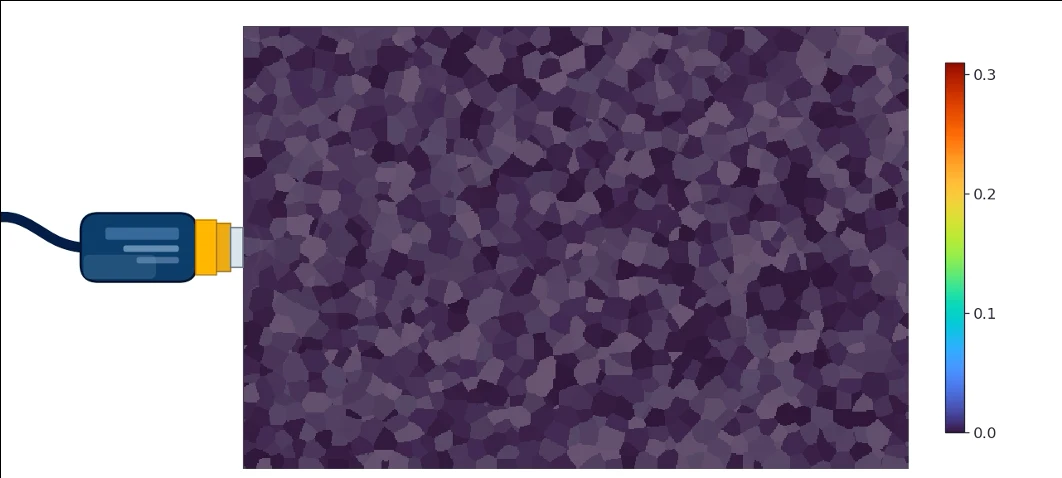
Mechanical waves carry information about the medium they travel through. In heterogeneous materials, that information emerges from interactions across grains, interfaces, and length scales. Numerical models help connect those interactions to signals that can be measured in an experiment.
Our computational work examines elastic-wave propagation in microstructured and anisotropic materials. We connect physical formulations of wave motion with numerical methods to investigate how material structure shapes the wave field.
Connecting a model to a measurement
A useful simulation does more than visualize a wave. It allows us to isolate the effects of material symmetry, heterogeneity, geometry, and initial stress, then ask which features remain visible in an ultrasonic measurement.
Our research includes stress formulations of elastic wave motion and finite-difference modeling. These approaches complement experimental studies of scattering and material characterization.
Questions we investigate
- How does material heterogeneity change propagation and multiple scattering?
- How can wave models represent anisotropy and initial stress?
- Which numerical formulations reveal the physics behind an observed signal?
QUESTIONS LEAD TO DISCOVERY
Let’s explore
what’s possible.
Interested in wave mechanics, materials,
or a new research collaboration?